

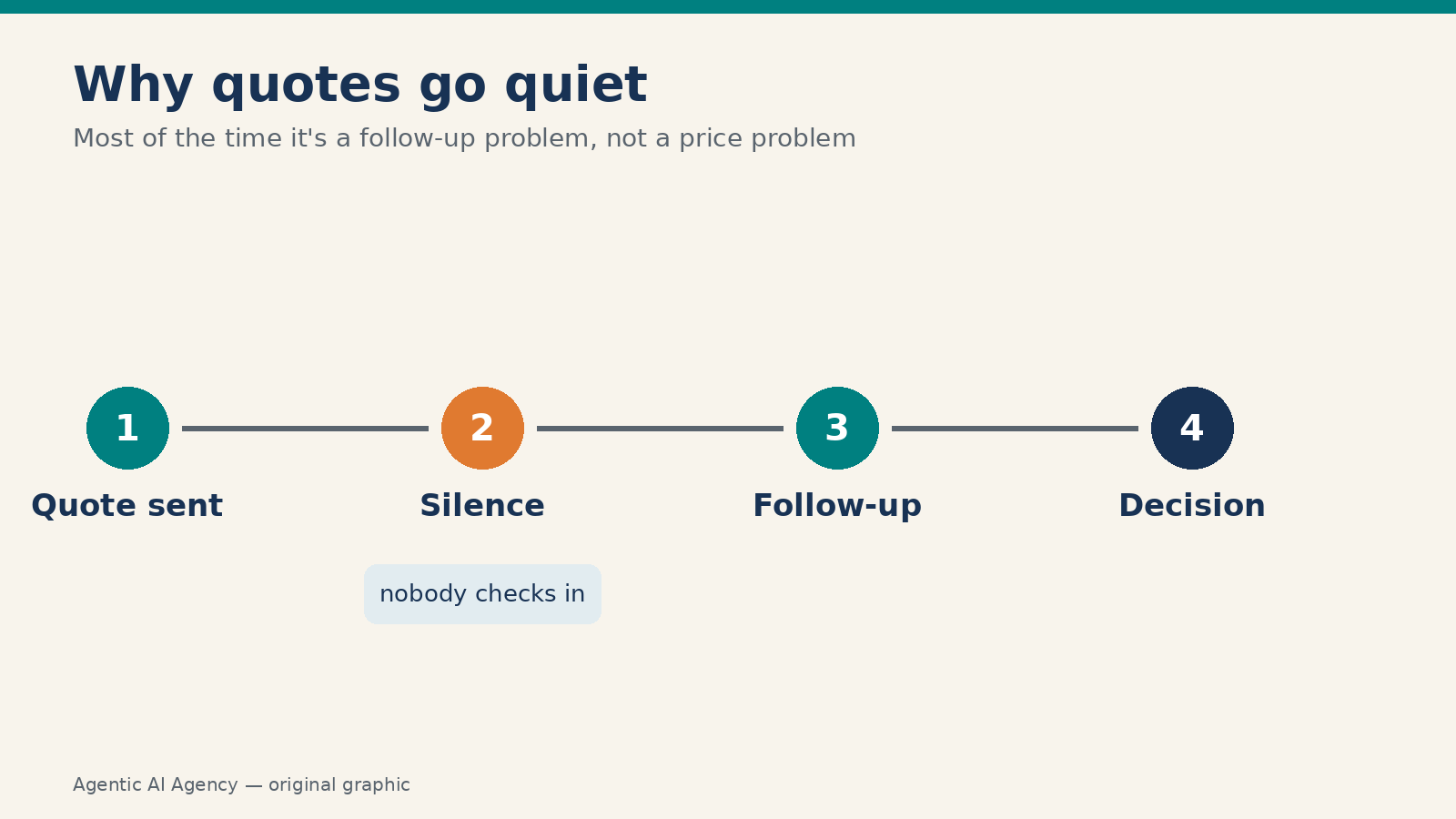
A homeowner asks three builders to quote on a bathroom renovation. One rings back within two days. One sends the quote and is never heard from again. One replies, but the quote ends up buried under a week of other emails. None of those homeowners said no. The quotes just went quiet, and that happens […]
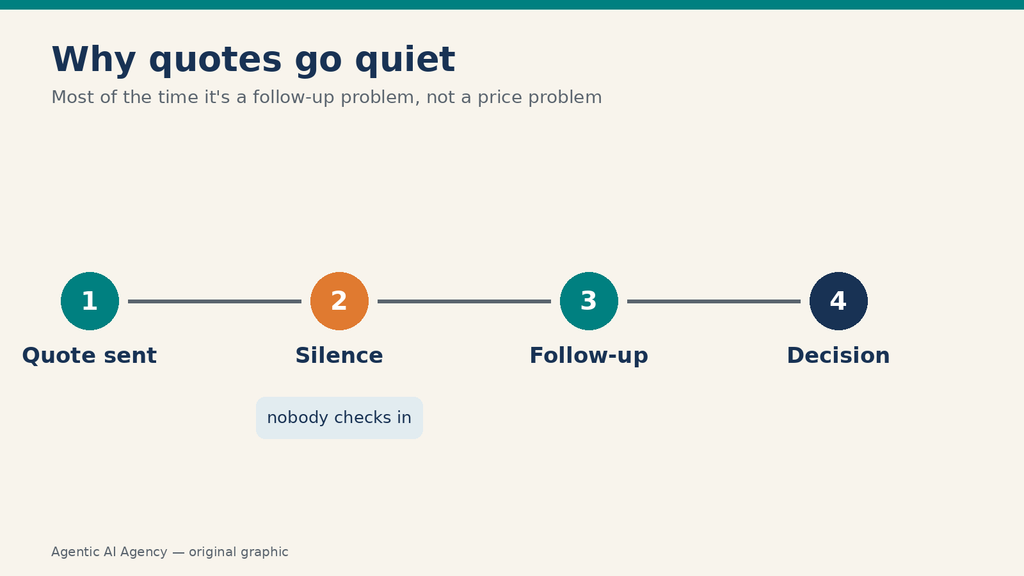
A homeowner asks three builders to quote on a bathroom renovation. One rings back within two days. One sends the quote and is never heard from again. One replies, but the quote ends up buried under a week of other emails.
None of those homeowners said no. The quotes just went quiet, and that happens a lot in renovation work. This guide is for renovation businesses and trades who want to follow up on quotes without chasing people or losing track of them, and it looks at where automated quote follow-up workflows help and where a person should step in. It also covers what homeowners can reasonably expect from a good follow-up.
Why quotes go quiet
Most quotes don’t fail on price. They fail because life gets in the way:
- The homeowner is comparing several quotes and is in no hurry.
- The quote landed at a bad time, such as the weekend before a school holiday.
- The next step wasn’t clear, so nobody did anything.
- The builder was on a site all week and forgot to check in.
The last two are in your control. A steady, polite follow-up fixes both, and that is where a little automation can help.
When automating follow-ups makes sense
You don’t need software for everything. If you send two or three quotes a month, a diary reminder is plenty. Automation starts to earn its keep when:
- You send quotes in batches. Several a week means someone will slip through.
- Follow-up depends on memory. If it only happens when you’re not busy, it won’t happen in busy weeks, which are the weeks you quote the most.
- Enquiries arrive after hours. A quick “we’ve got your request” message at 9 pm sets expectations until you can call back.
- You can’t say how long quotes sit before anyone checks in. If you don’t know, it’s probably too long.
When not to automate
Some parts of a renovation job need a person. Keep these out of any automated sequence:
- Site visits and measuring. A message can’t tell whether a wall is load-bearing or a bathroom floor has water damage.
- Anything that needs a licensed tradesperson’s judgement. Electrical, plumbing, gas and structural work must be assessed and carried out by licensed Australian professionals. An automated message should never give technical advice on these.
- Variations and price changes. If the scope or cost changes, a person should explain why and get the change agreed in writing.
- Bad news. Delays, extra costs and complaints deserve a call.
- Customers who’ve replied. The moment someone answers, the automation should stop and a named person should take over.
A simple five-touch sequence
Here is a sequence that fits most residential quotes. It spreads five short messages over about a month.
| Day | What happens | Channel |
| 0 | Confirm the quote was sent and say what happens next | |
| 2 | Short check-in: did it arrive, any questions? | SMS |
| 7 | Offer a call or a second look at the scope | Email or phone |
| 14 | Mention the quote’s expiry date | SMS |
| 30 | Close the loop politely |
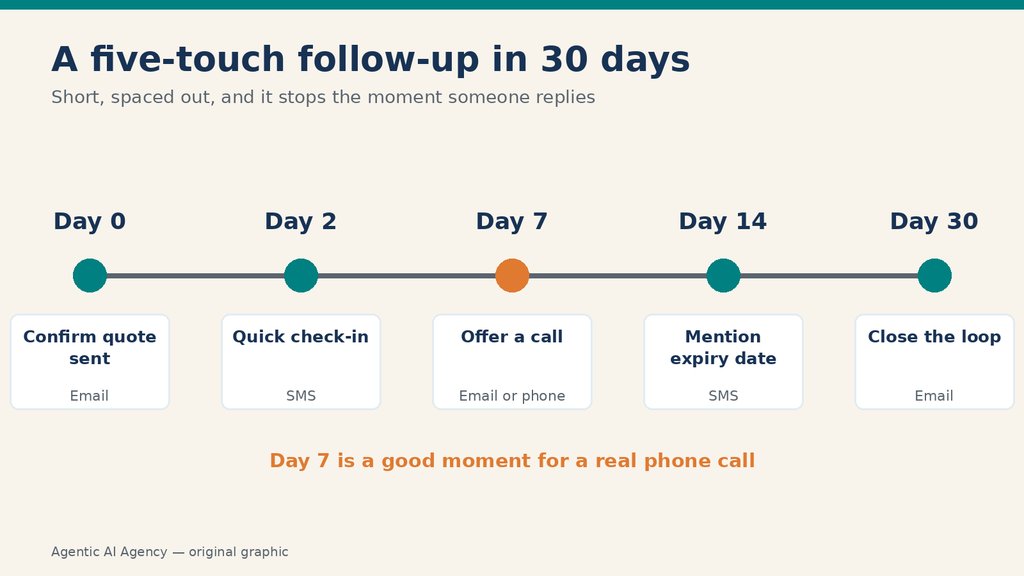
Day 7 is a good place for a person to pick up the phone. It’s the point where a short conversation often answers whatever has been holding the decision up.
Example messages
These are examples only. Change the wording to sound like your business.
Day 0 (email)
Subject: Your bathroom renovation quote from [Business name]
Hi [Name], thanks for having us out on [day]. Your quote is attached. It covers the scope we discussed and is valid until [date]. If anything isn’t clear, reply here or call me on [number]. – [Your name], [Business name], ABN [number]
Day 2 (SMS)
Hi [Name], it’s [Your name] from [Business name]. Just checking the quote for your bathroom reached you OK. Happy to go through it if you have questions. Reply STOP to opt out.
Day 14 (SMS)
Hi [Name], a quick note that your quote is valid until [date]. If your plans have changed, no problem, just let me know. Reply STOP to opt out.
Day 30 (email)
Hi [Name], I haven’t heard back, so I’ll assume the timing isn’t right and close your quote for now. If you’d like to revisit it later, reply any time and I’ll update the pricing. Thanks for considering us. – [Your name]
Notice what’s missing: no pressure, no “last chance” language, and no prices in the messages. Pricing belongs in the quote itself, not in a quick text.
Keeping a person in the loop
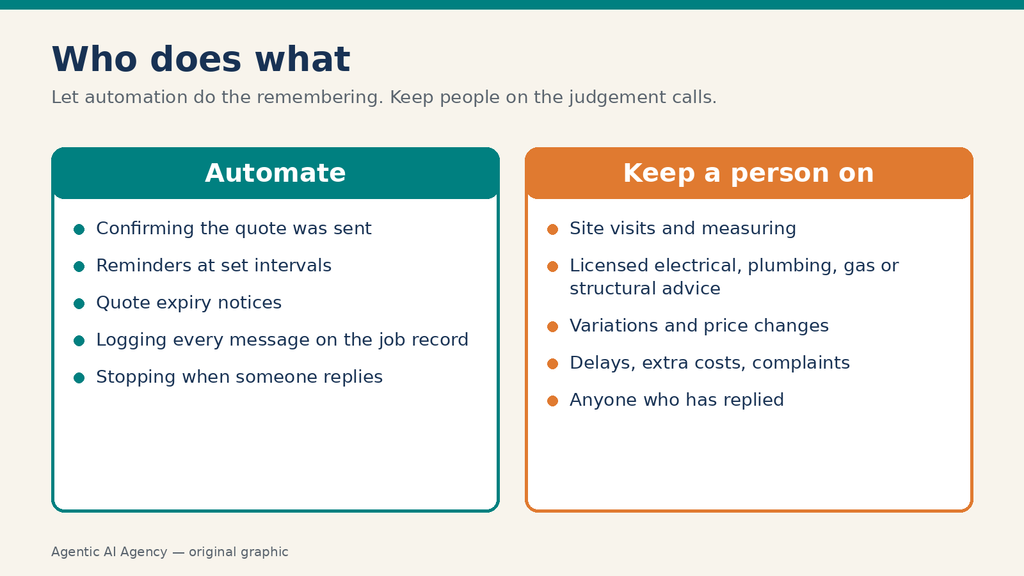
Treat automation as the thing that remembers and a person as the thing that responds. A few habits keep that balance:
- Stop on reply. If a customer replies by SMS, email or phone, pause the sequence straight away.
- Name a human. Messages should come from a real person at your business, with a number that gets answered.
- Put variations in writing. If a customer asks for a change after the quote, confirm the new scope and price in writing before work starts.
Plug it into the tools you already use
Before you buy anything, check what your current quoting or job management software can already do. Many have quote reminders built in, and a simple “quote sent” status is often enough to trigger a message.
If you do connect separate tools, keep it simple:
- Pick one place as the record of every quote and its status.
- Make “quote sent” the trigger that starts the sequence.
- Log every automated message on the customer’s record, so whoever calls next knows what’s been sent.
- Make “accepted”, “declined” or “customer replied” stop the sequence.
Write the process on one page first. If it won’t fit on a page, it’s too complicated to automate.
Know the rules for SMS and email
Follow-up messages can count as marketing in some situations. Australia’s Spam Act 2003 sets rules about consent, identifying yourself and making it easy to unsubscribe. That’s why the examples above name the business and include a way to opt out. Read the ACMA’s guidance and, if you’re unsure how it applies to you, get advice. This article is general information only.
How to measure whether it’s working
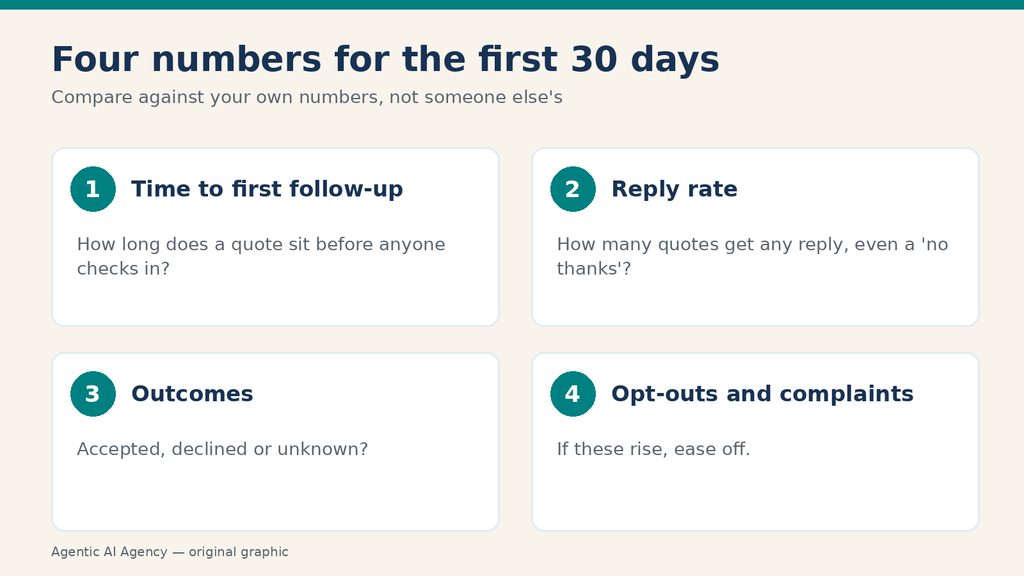
Over the first 30 days, track four things:
- Time to first follow-up. How long does a quote sit before anyone checks in?
- Reply rate. How many quotes get any reply, even a “no thanks”?
- Outcomes. How many quotes end up accepted, declined or unknown?
- Opt-outs and complaints. If these rise, your messages are too frequent or too pushy.
Compare against your own numbers from before you started. Other businesses’ figures don’t tell you much about yours.
Mistakes to avoid
- Sending “just checking in” every time. Each message should give a reason to reply, such as an expiry date or an offer to talk it through.
- Chasing too hard. Five touches over a month is plenty. Stop after that.
- Messaging after a “no”. Mark declined quotes straight away.
- Odd hours. A message at 10 pm feels pushy, however polite.
- Forgetting to update the record. If you speak to someone by phone, update their status so the sequence doesn’t send a reminder afterwards.
What homeowners can expect
If you’re the one waiting on quotes, a good follow-up should feel helpful, not pushy. A good quote is written, describes the work, itemises the costs and shows an expiry date. business.gov.au lists what a written quote should include, which is a handy checklist when you compare quotes.
Be wary if a builder refuses to put things in writing, won’t explain what’s included, or insists the price is only good “today”. It’s fine to take your time and ask questions. And if you’ve decided to go with someone else, a quick “no thanks” helps the builder close the file and stops further messages.
Electrical, plumbing, gas and structural work must be done by licensed Australian professionals. This article is general information, not legal or financial advice.
About the author
Saurabh Bisht is the founder of Agentic AI Agency. He has implemented enterprise AI search for an organisation and built custom workflow automations, AI receptionists and other AI solutions for business clients.